Executive Summary
The Premise: The AI revolution promised to make us faster. Instead, it made us project managers for five different robots.
The Product: Aether is a Unified AI Operating System that aggregates disparate models (GPT-4, Claude, Midjourney, Cursor) into a single workspace. It abstracts API costs into a universal currency and maintains persistent context across the entire product lifecycle.
The Problem: "The Alt-Tab Hell"
It is 11:30 PM on a Tuesday. Meet Alex, a Product Designer trying to launch a simple landing page for his side project. He is capable and motivated, but he is currently paralyzed by SaaS Fragmentation.
The Scenario
Subscription Fatigue
Users are overwhelmed by managing $20/mo + $30/mo + $10/mo subscriptions, all while watching five different credit meters drain.
Context Amnesia
Every time Alex switches tools, the AI "forgets" the project details. He acts as a human clipboard, shuttling context between tools that refuse to talk to each other.
The "Aggregator" Gap
Current tools like Poe or Perplexity focus on chatting, not doing. There is no "ClassPass for AI" that unifies functional tools (Design + Code + Deploy) under one roof.
The Solution: Aether Workspace
"Stop managing the robots. Just do the work."
The "Universal Fuel" System
Solving Cost Anxiety
The Model: Inspired by ClassPass and Arcade tokens. Instead of tracking "Tokens" in ChatGPT and "Fast Hours" in Midjourney, the user buys Aether Points.
The Abstraction: We hide the raw API costs behind a friendly currency. 100 Aether Points = $30/month.
- Writing a blog post ≈ 1 Point
- Generating an UI in Visily ≈ 2 Points
- Vibe coding for an hour ≈ 10 Points
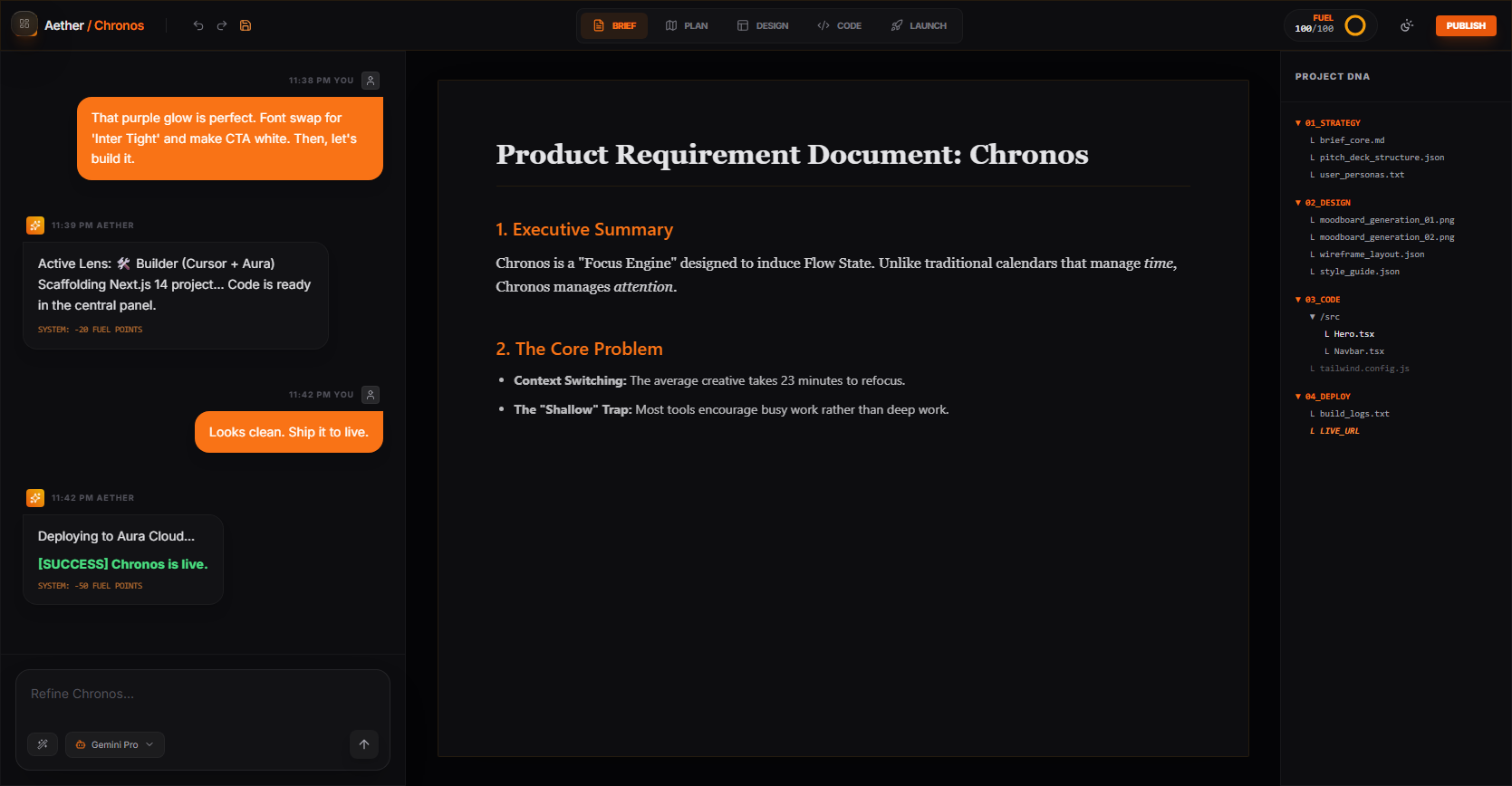
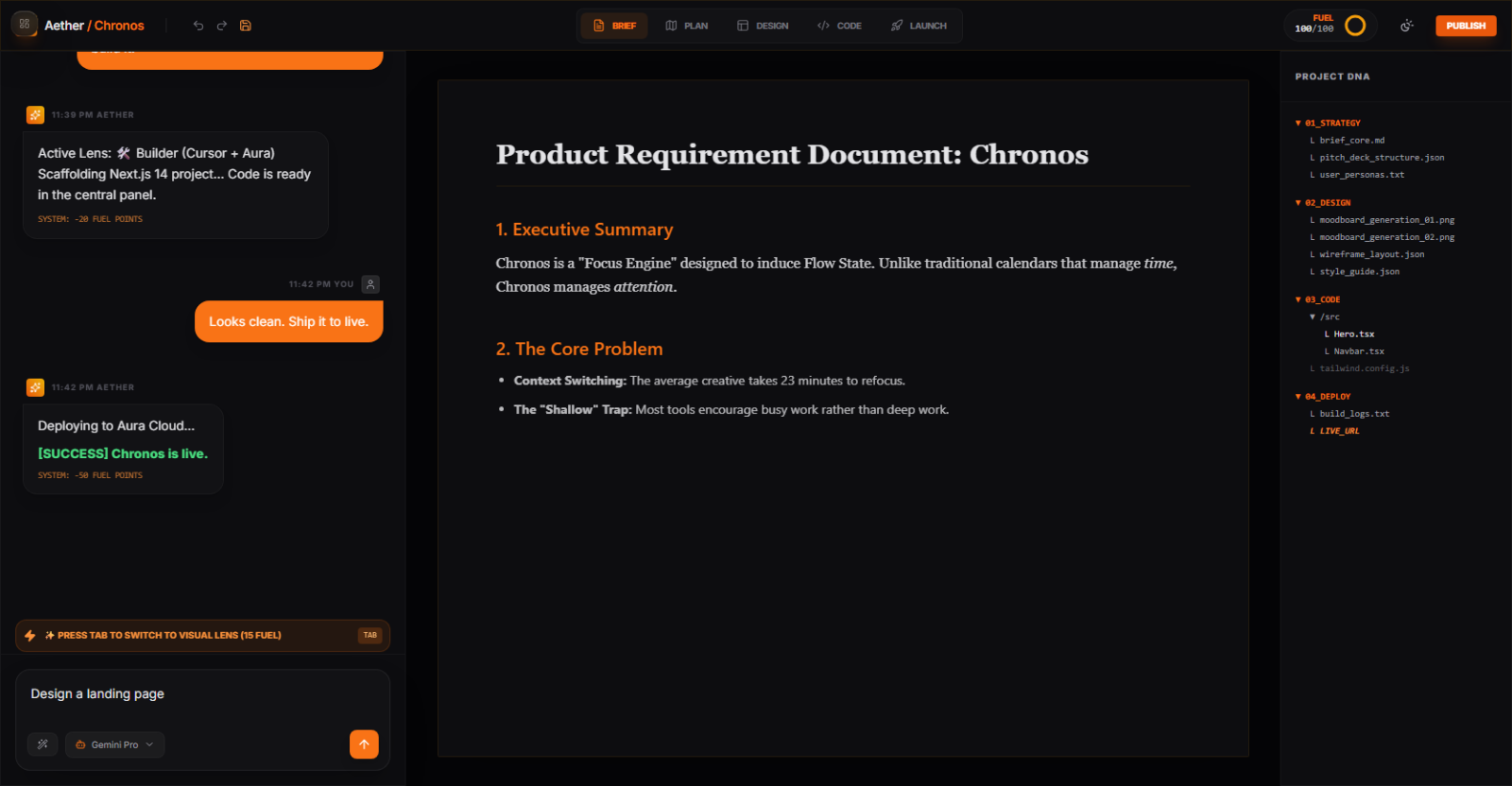
The UX Fix: A minimal "Fuel Gauge" ring. It replaces the countdown anxiety with a resource management visual.
Component Preview
▼ 01_STRATEGY
L brief_core.md
L pitch_deck_structure.json
L user_personas.txt
▼ 02_DESIGN
L moodboard_generation_01.png
L moodboard_generation_02.png
L wireframe_layout.json
L style_guide.json
▼ 03_CODE
▼ /src
L Hero.tsx
L Navbar.tsx
L tailwind.config.js
▼ 04_DEPLOY
L build_logs.txt
L LIVE_URL
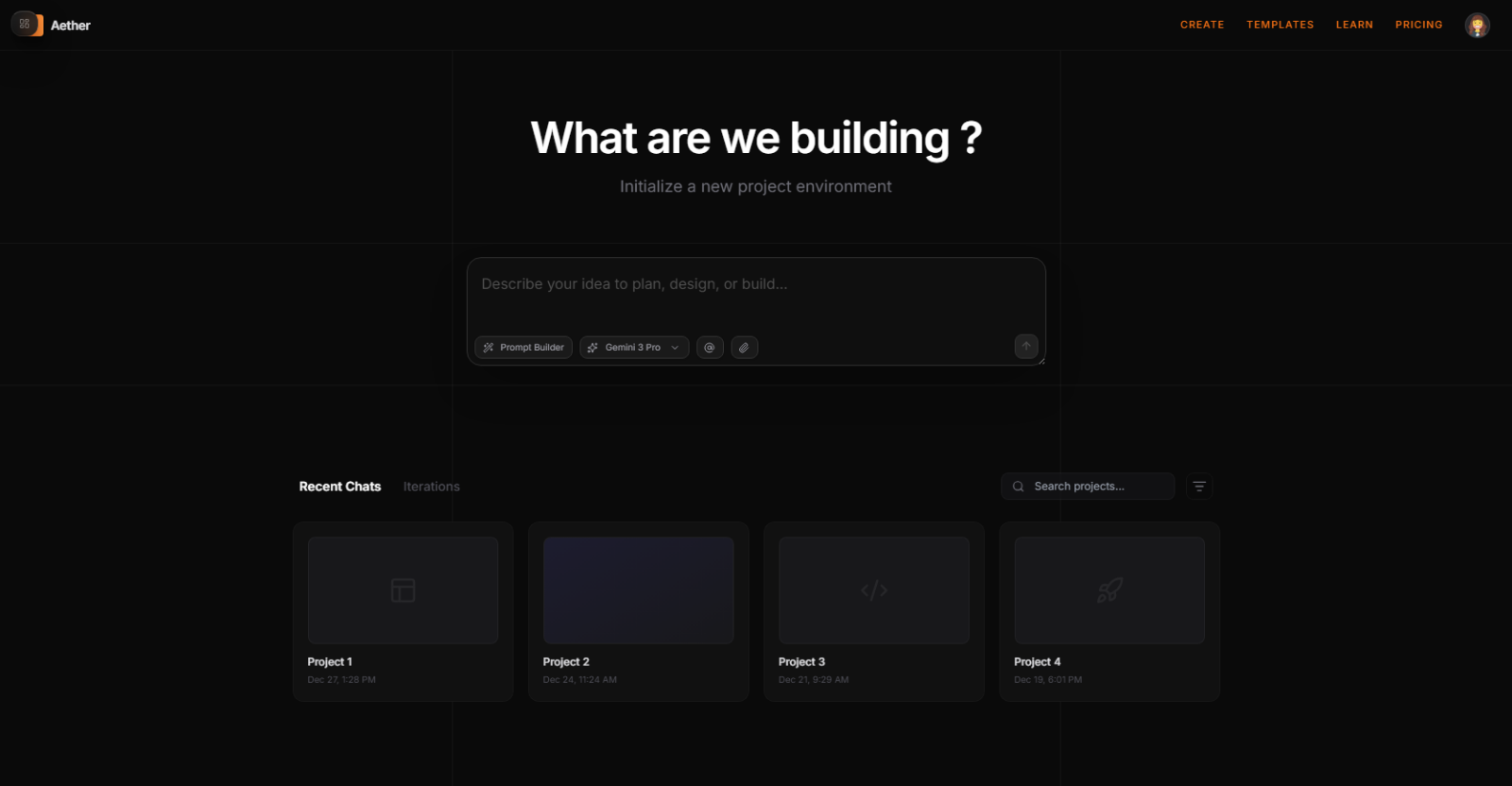
Project DNA
Solving Context Amnesia
The Architecture: A persistent file system (The "Right Panel") that travels with the user. It utilizes the Model Context Protocol (MCP) to standardize how different AIs read data.
The "Context Snowball": Data accumulates automatically as the user works.
Adaptive Lenses
Solving Tool Fatigue
The Interface: Instead of opening 5 different apps, Aether is One Infinite Canvas. The interface morphs based on the "Lens" you are using.
Thinking Lens
Powered by Gemini/Claude. Document/Chat structure.
Visual Lens
Powered by Midjourney/Relume. Design canvas.
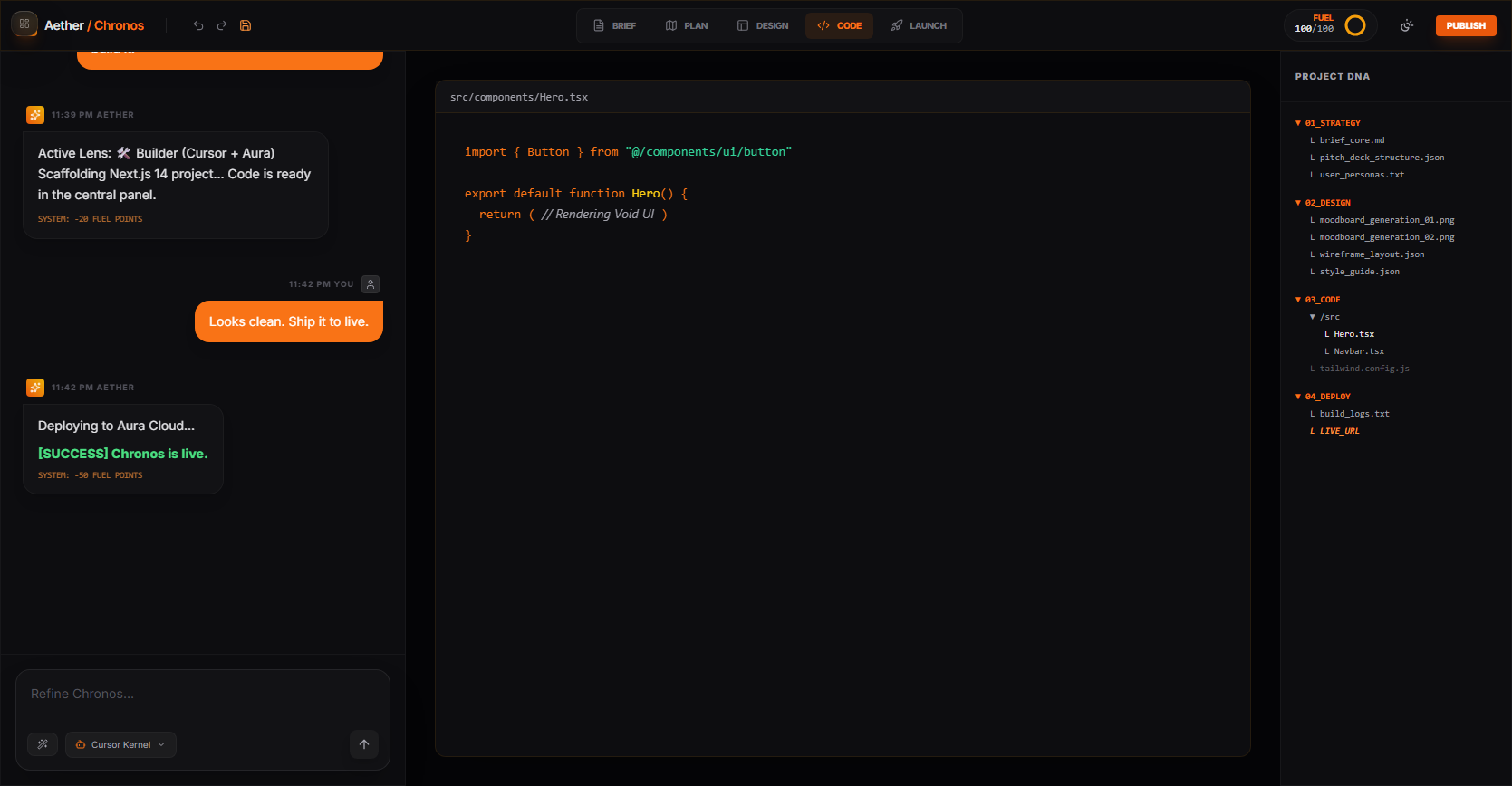
Builder Lens
Powered by Cursor/Aura. Terminal/IDE feel.
Component Preview
Interaction Design
A. Manual Control: The Omni-Bar
Allows the user to "Hot-Swap" the active intelligence engine at any time.
Example: Switch from Gemini to DeepSeek R1 for a riskier critique without losing context.
B. Auto-Suggestion: The "Intent Chip"
Real-time input analysis proposing shifts. If a user types "show me the hero section," the interface proactively offers a tool switch.
Component Preview
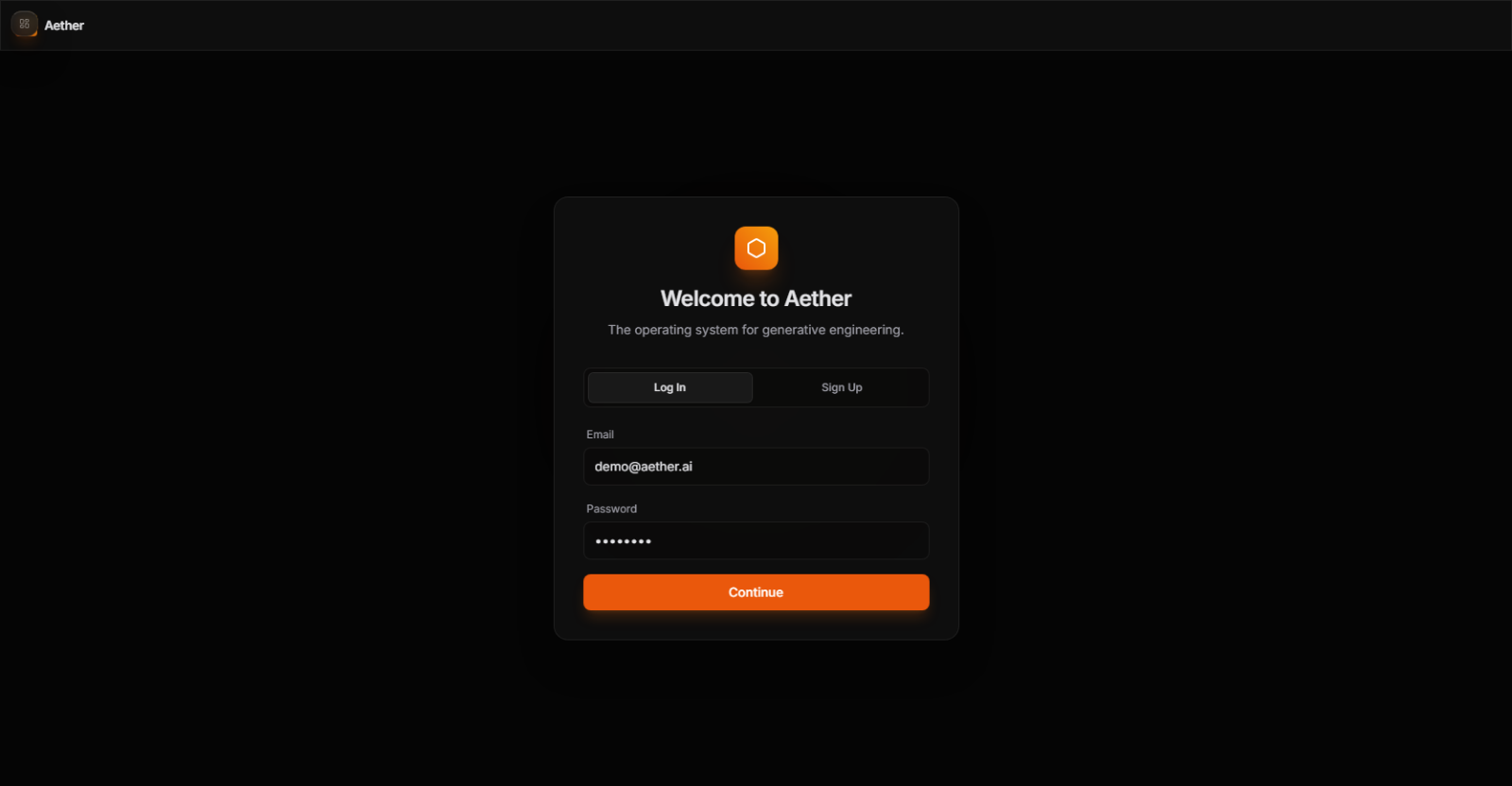
Interface Gallery
Business Strategy & Viability
1. Unit Economics
The "Smart Routing" UX. Simple queries go to cheaper models (Gemini Flash) invisibly. Business saves margin, user feels speed.
2. Retention
By storing the project's history and context inside Aether's Project DNA, leaving the platform becomes "expensive" for the user because they lose their project's "Brain."
3. Monetization
The "Fair Use" Cap. Hobbyist vs Pro tiers via Fuel system. Top-ups convert high liability users into revenue sources.
Competitive Comparison
| Feature | Google AI Studio | Poe / Perplexity | Aether (Our Concept) |
|---|---|---|---|
| Primary Goal | Build AI apps (Devs) | Chat & Search | Create Products (Creators) |
| Context | Session-based | Ephemeral | Persistent (Project DNA) |
| Integrations | API / Python | None | Deep Links (Figma/Cursor) |
Technical Feasibility
The Model Context Protocol (MCP) allows Aether to act as a "Host" for the file system.
Walled Gardens. Tools like Midjourney do not have public APIs.
Aether uses browser automation agents for tools without APIs, while using direct enterprise APIs for OpenAI and Anthropic.
Aether changes the paradigm from "Using Tools" to "Collaborating with a System."
40%
Reduction in time-to-value
100%
Unified Fuel System
LIVE
Sustainable Aggregator
Next Steps
Develop the mobile companion app for "On-the-go Ideation" that syncs to the Project DNA.